From Panic to Peace: How CBT Therapy Transforms Anxiety
The first time I saw a client have a full panic attack in session, she was convinced she would die on my office floor. Her heart hammered, her hands shook, and she could not catch a full breath. We paused, slowed down, and did something counterintuitive. Rather than fight the sensations, we invited them in. She learned that the storm inside her body was intense, but not fatal. Six weeks later, that same client walked around a crowded store she had avoided for years. She put items in the cart, stood in line, and noticed the same wave of sensations. This time, she had names for them, tools to surf them, and a brain that no longer treated them as proof of danger. That arc from panic to peace is what well-delivered CBT therapy can do.
Anxiety therapy is not a monolith, and anxiety is not a single problem. Panic disorder, generalized anxiety, health anxiety, social anxiety, and trauma-related anxiety have their own flavors. The core idea that binds effective approaches together is learning. The brain updates its maps when predictions fail safely. CBT gives you structured chances to create those safe failures. Over time, the habit of fearing fear loosens.
What panic is really doing
During a panic attack, your body misreads everyday sensations as threats. Carbon dioxide rises slightly after a sprint to the train, your chest tightens, and your brain pairs that with worst-case thoughts about suffocating or passing out. Adrenaline surges, which speeds your heart and pulls blood to large muscles. Hands tingle, vision narrows, stomach flips. You scan the room for exits and steady objects. You might call someone, check your pulse, or leave the line. The urgent relief that follows teaches your brain a harsh lesson: escape works. Next time you feel a flutter, the brain pushes escape even faster.
The problem is not the sensations, it is the cycle. Catastrophic interpretation plus rapid escape cements the false link between bodily arousal and catastrophe. Anxiety becomes the problem, not the event that triggered it. The loop tightens until even thinking about a store aisle or elevator sparks symptoms. CBT treatment unwinds the loop by changing how you interpret sensations and how you act when they appear.
How CBT therapy approaches anxiety
CBT therapy, in practice, is not a pep talk. It is collaborative, practical, and measured. We start by mapping your anxiety cycle in plain language: trigger, thought, feeling, body signals, actions, and results. Then we run targeted experiments to collect new evidence. You learn to notice thoughts as hypotheses, not facts, and to test them with behavior. The method draws on learning theory and prediction error research, but the feel in the room is down to earth. We write things down, set specific goals, and track progress session by session.
CBT has a strong evidence base across anxiety disorders. For panic disorder and agoraphobia, brief protocols of 8 to 16 sessions can reduce attack frequency dramatically. For social anxiety and OCD, longer courses are typical. Recovery timelines vary because people vary. Prior trauma, medical conditions, and co-occurring depression change the pace. Medications can help, especially SSRIs, but they do not teach the brain new rules for sensations and situations. Behavioral learning does.
What the first month looks like
We usually spend the first visit clarifying the problem, history, and goals. I ask for specific examples, not labels. “Tuesday at the pharmacy, I left my basket in line and sat in the car for 20 minutes.” That has far more value than “I have bad anxiety.” We rate distress during and after the event, list what you did to cope, and note what you avoided. By the end of session one, you will understand the panic cycle and leave with one or two small tasks, like recording symptoms when they spike instead of immediately checking your pulse.
In weeks two and three, we add skill practice and begin exposure planning. If panic is central, we often start with interoceptive exposure, which means deliberately provoking body sensations in a controlled way. Think spinning in a chair to feel dizzy, running in place to raise heart rate, or breathing through a narrow straw to mimic air hunger. This sounds like the last thing you would want to do. It is also the fastest way to teach the brain that the sensation is uncomfortable, not dangerous. We run the exercise until the fear drops, not until the sensation disappears.
By week four, you should be testing your feared situations. Standing in a short line, driving over a bridge, taking the elevator two floors, filming a brief video to post for social anxiety. We collect data after each task. How high was the peak fear on a 0 to 100 scale. How long did it last. What safety behaviors did you use, like leaning on a wall or gripping the cart. What actually happened.
The building blocks that matter most
- Exposure to feared sensations and situations, without safety behaviors
- Cognitive restructuring that treats thoughts as testable predictions
- Skills for tolerating arousal in the moment, like paced breathing
- Behavioral activation for low mood that often accompanies anxiety
- Relapse prevention planning so gains last beyond therapy
These are not abstract categories. They are reproducible habits you can practice and measure.
Exposure therapy without white-knuckle suffering
Many people avoid therapy because they imagine exposure as forced flooding. Good exposure is graded, collaborative, and focused on learning, not endurance. We design tasks that are challenging enough to activate fear, but not so hard that you cannot engage your curiosity. Before a task, we write down your catastrophic predictions, as clearly as a weather forecast. During the task, we drop safety behaviors. After the task, we compare what actually happened to the prediction.
Interoceptive exposure for panic stays in the room, which makes it a useful early win. For example, a client who feared passing out did 30 seconds of hyperventilation to induce lightheadedness. We planned a safe setup, including a chair in case she needed to sit. She reached an 80 out of 100 fear rating in the first 10 seconds, then started narrating the sensations. “Hard to focus, buzzing in fingers, chest pressure.” Within 2 minutes of stopping, her fear rating fell to 25. Over four repetitions, it dropped to 10. She discovered something big. The sensations that had run her life were self-limiting. She did not faint. Her blood oxygen was fine. The next week, she stood in a store line and used the same narration rather than escaping.
People worry that interoceptive exercises might be unsafe. We screen for conditions where certain drills are not appropriate, like severe asthma for straw breathing, uncontrolled cardiac disease for intense exertion, or vestibular disorders for spinning. If something is off-limits, we choose other drills that capture the core fear without medical risk. The aim is not to push through at any cost, it is to find a clean way to unpair sensations from catastrophe.
Situational exposure comes next. I had a client who avoided highway driving for three years after one panic episode at 65 miles per hour. We started with service roads at off-peak times, moved to a quiet stretch of highway at 45 miles per hour, and later added lane changes and mild traffic. He practiced four days per week, sessions of 20 to 30 minutes. After six weeks, he drove to visit his sister two hours away. His fear never fell to zero, but his confidence rose enough that fear no longer set his radius.
Rethinking thoughts without arguing with them
Cognitive work in CBT is often misunderstood as positive thinking. It is closer to good journalism. You learn to find the headline your brain is running and check the source, scope, and evidence. If your thought is, “If my heart races in public, I will pass out and humiliate myself,” we ask three things. How likely is that, given your actual history. If it did happen, how bad would it be, and what would you do next. What is the effect of holding this belief on your behavior right now.
In practice, we use brief thought records or on-the-spot questions. During a feared task, clients carry a card: Prediction, Safety behaviors to drop, What happened, What I learned. Some also track probability estimates. If your first estimate is 80 percent that you will faint in a grocery aisle, check it after three exposures. Most people lower that number by half after a few weeks, not because I told them to, but because their data forced an update.
We also challenge certainty about control. A common belief is, “I must keep my anxiety below a 30 out of 100 to function.” That belief narrows your life. We test the counter-hypothesis that you can function with a 70, imperfectly but adequately. That is not an inspirational quote, it is a muscle you build by doing ordinary things while physiologically amped. Anxiety stops being a stop sign and becomes a yellow light.
Skillful arousal management, not suppression
Trying to calm down as a rule is a trap. The more you chase calm, the more you monitor symptoms, and the more anxious you feel when they do not budge. Still, a few skills help you ride the wave.
Paced breathing is my mainstay because it lowers the mechanical driver of breathlessness without forcing relaxation. Try five or six breaths per minute, light and quiet, with a slightly longer exhale. If you tend toward hyperventilation, this rate corrects the imbalance without breath holding. Another is grounding through the senses. Pick a small object and describe it to yourself for 30 seconds, all the way from texture to color to temperature. This pulls attention from catastrophic imagery to concrete data.
Muscle tension and trembling often scare clients. Paradoxically tensing a muscle group for five seconds, then releasing, can reveal that you have been bracing all over. The contrast, not the command to relax, does the work. And when worry spirals at night, schedule a 15 minute worry period earlier in the day. Write, do not ruminate in bed. You will not eliminate worry, but you will contain it.
When anxiety is welded to trauma
For some people, the panic cycle sits on top of old trauma. A car accident leaves you jumpy on highways. A medical scare during childbirth turns any bodily change into a siren. Trauma therapy addresses the memory nodes, the images, and the trapped physiological responses that keep firing long after the threat is gone.
Two approaches I often blend with CBT are IFS therapy and Accelerated Resolution Therapy. IFS therapy helps you meet the parts of you that carry fear, shame, or protectiveness, and it builds internal leadership so those parts do not have to run the whole show. Someone with a vigilant protector part might resist exposure work by flooding you with reasons to avoid. Working with that part respectfully, in its language, clears the logjam. IFS is experiential and can be slower paced, which suits clients who need trust and safety before they can touch fear directly.
Accelerated Resolution Therapy uses sets of eye movements, image rescripting, and voluntary memory reprocessing. You visualize the worst moments, then deliberately change elements of the scene while the therapist guides lateral eye movements. Many clients report rapid reduction in distress associated with specific images after one to three ART sessions. For a client who panicked every time she saw the stretch of road where her accident occurred, ART helped de-link the image from a flood of adrenaline. We then returned to CBT exposures and found they went smoother. ART is brief and focused, but it is not a substitute for practicing life skills in the world. Combine it with CBT to update both the memory and the behavior.
A case story, details changed
Maria, 34, developed panic attacks after a flu that left her dizzy for a week. The illness resolved, but the fear of dizziness stuck. She stopped grocery shopping alone, leaned on walls in hallways, and carried water everywhere. Her first session score on the Panic Disorder Severity Scale - Self Report was 14, in the moderate range. She slept six hours per night, scrolled late, and drank three cups of coffee each morning.
We started with education about the panic cycle, then set specific goals. She wanted to stand in a checkout line for 10 minutes without leaving and drive to work on the highway again. Week two, we cut caffeine to one cup before 10 a.m., added a regular sleep window, and began interoceptive exposure with head tilts and spinning to induce dizziness. Maria’s fear reached 75 out of 100 on the first spin. She repeated it five times, rating fear after each round. It dropped to 20.
Week three, we did exposure in a grocery store. She planted her feet in a quiet aisle and allowed dizziness to crest. No leaning on the cart, no calling her husband, no checking her pulse. She felt shaky for three minutes, then it eased. We repeated it in a busier aisle. By week five, she stood in a fast checkout line. Prediction on paper before the task: 60 percent chance of needing to flee. Actual outcome: stayed, fear peaked at 65, then fell to 25.
Midway through treatment, a trauma memory surfaced. When she was 12, she fainted on a hot day at a school assembly. Peers laughed, and a teacher scolded her for skipping breakfast. We used one session of Accelerated Resolution Therapy to rework the vivid image and the shame glued to it. The next week, her self-criticism when dizzy softened noticeably. Session eight, she merged onto the highway at 7 a.m. And drove 12 miles. Session ten, her PDSS-SR score was 5. She still got surges of dizziness twice per week, and she practiced letting them pass without changing course. We scheduled booster check-ins at one and three months. She kept gains, with a single slip after a stressful week. Because she had a plan, the slip stayed small.
Troubleshooting the sticky spots
Perfectionism is a common snag. Clients wait for the perfect week to start exposures, the perfect script before a hard conversation, the perfect calm. Anxiety thrives in those delays. Better to set a low bar you can clear, like two exposures of 10 minutes each, than aim for five you never schedule.
Reassurance seeking gives short-term relief and long-term trouble. If you text a partner for constant comfort, you teach your brain the same rule as fleeing a line. Both become required for short-term safety, and both maintain anxiety. We plan graduated reductions in reassurance, with your partner’s help. That might mean they reply once per day to anxiety check-ins, not ten times.
Health concerns complicate the picture. If your heart sometimes races due to arrhythmia, or you have asthma, you need a medical evaluation before starting certain interoceptive exposures. Once cleared, we tailor drills so they map to your fear without pushing unsafe boundaries. For example, if shortness of breath is a deep fear but your lungs are sensitive, we may use breath-holding for brief periods instead of straw breaths.
Medication can be a support or a source of confusion. Benzodiazepines reduce anxiety quickly, but when taken frequently, they blunt learning during exposure. If you rely on them to get through tasks, we discuss timing or tapering with your prescriber. SSRIs often help by lowering the background noise of fear, which can make exposure practice more approachable. The goal is not to prove you can do it medication free. The goal is to learn and keep what you learn.
Caffeine, alcohol, and cannabis matter more than people expect. Two strong coffees plus a poor night’s sleep can mimic panic physiology closely. I am not anti-caffeine, but I ask clients to run one to two week experiments with reduced intake, earlier cutoffs, and better hydration. Alcohol and cannabis may take the edge off initially, then rebound with more anxiety and sleep disruption. Small, measured changes often produce outsized gains.
Co-occurring conditions change the path. If you have OCD, the form of exposure is more precise, called exposure and response prevention. If generalized anxiety dominates, we work more on uncertainty tolerance and scheduled worry. If trauma symptoms lead the room, we may start with stabilization, parts work, or ART before leaning into exposure. Therapy is not one menu for all.
Two quick experiments you can try this week
- Track your fear peak and recovery time during one anxiety episode. Use a 0 to 100 scale. You are measuring shape, not blaming yourself for numbers.
- Choose one safety behavior to drop in a low-stakes situation. For example, do not check your pulse during a short walk. Note what happens.
- Practice six breaths per minute for three minutes, twice per day, regardless of how you feel. Treat it like brushing your teeth.
- Run one interoceptive drill for 30 seconds, like head shaking or jogging in place, then sit and watch your body settle. Repeat three times.
- Write your top catastrophic prediction for a planned activity. Do the activity. Compare data to prediction, then adjust the prediction for next time.
Keep these experiments small and repeatable. If a drill spikes symptoms beyond what feels workable, lower intensity and try again, or wait until you can discuss it with a clinician.
Measuring progress so your brain believes it
Anxiety fades unevenly. Some weeks you will feel freer, then a bad day convinces you nothing has changed. Data protects you from that story. I ask clients to graph feared situations practiced per week, average peak fear, minutes spent in exposure, and the number of avoided situations. Even a simple tally on a sticky note works. You want to see the practice volume rise before fear consistently drops. The graph often looks like a staircase, not a glide.
Relapse prevention starts before discharge. We identify situations likely to spark return of fear, early warning signs like rising reassurance seeking, and the smallest first steps to get back on track. I frame lapses as bruises, not breaks. Expect two or three in the first six months. If you rehearse your response before you need it, you will spend less time in the ditch.
Finding the right therapist
Not every clinician uses the same playbook, and fit matters. When interviewing potential providers, ask how they structure anxiety therapy, how often they assign between-session practice, and how they measure change. Look for someone who can describe exposure in plain terms and who seems comfortable coaching you through discomfort. If your history includes trauma, ask whether they integrate trauma therapy, IFS therapy, or Accelerated Resolution Therapy, and how they decide when to use which.
Practical details matter. Many CBT courses for panic fall in the range of 8 to 16 weekly sessions. Fees vary widely by region. I see ranges from 90 to 220 dollars Click here for more per session in many cities, with lower-cost options at training clinics. Insurance coverage can be good for CBT, but exposure sessions that run longer than 50 minutes may need special scheduling. Telehealth works well for much of the work, but in-person sessions are useful for certain exposures, like elevators, bridges, or crowded waiting rooms. The best plan is one that gets you practicing in the environments you want back.
Why this approach gives you your life back
If you strip anxiety therapy to its essentials, you are retraining a prediction machine. The brain keeps you alive by guessing what comes next and preparing you for it. CBT puts that guessing to the test in daily life, then edits the rulebook based on what actually happens. Trauma therapy updates the old memories that keep shouting. IFS therapy restores collaboration inside your own mind. Accelerated Resolution Therapy turns down the volume on haunted images so that exposures feel doable. Threaded together, these approaches transform panic into a signal you can tolerate and eventually ignore.
I have watched hundreds of clients relearn their bodies and their worlds. A man who had not flown in 12 years boarded a plane for his father’s birthday. A teacher who almost quit after a panic attack in front of her class taught the rest of the year. A new mother who feared leaving the house with her baby walked her neighborhood with a head high, stroller steady, phone zipped away. None of them became fearless. They learned that fear does not decide. That is the shift from panic to peace.
If you are starting from the floor of your own worst day, know this. The climb is uneven, but the steps are clear. Map your cycle. Practice feeling what you fear, briefly and often. Treat thoughts as forecasts to be tested, not orders to obey. Drop the crutches that feed the loop. When trauma tightens the knot, bring it into the work with methods built for memory and parts. Most of all, keep your experiments small, frequent, and honest. Peace grows from those reps.
Erika's Counseling
Name: Erika's Counseling
Address: 6696 South 2500 East, Ste 2A, Uintah, UT 84405
Phone: (208) 593-6137
Website: https://www.erikascounseling.com/
Email: [email protected]
Hours:
Sunday: Closed
Monday: Closed
Tuesday: 9:00 AM – 4:00 PM
Wednesday: 9:00 AM – 4:00 PM
Thursday: 9:00 AM – 4:00 PM
Friday: Closed
Saturday: Closed
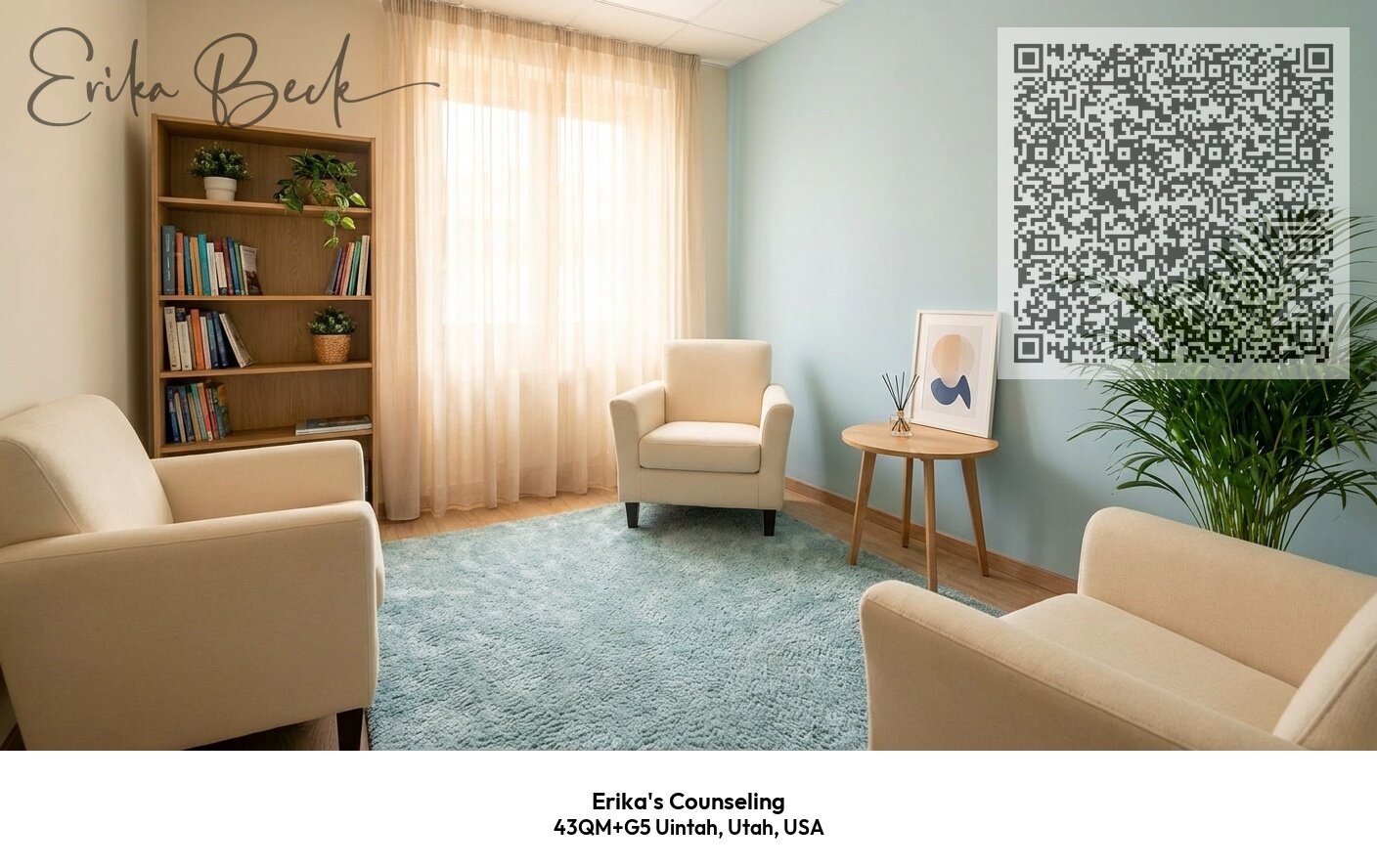
Open-location code / plus code: 43QM+G5 Uintah, Utah, USA
Coordinates: 41.138781, -111.9171075
Map/listing URL: https://www.google.com/maps/place/Erika%27s+Counseling/@41.138781,-111.9171075,651m/data=!3m1!1e3!4m6!3m5!1s0x875307cd5b7b0049:0x18b6b07ca7fe6b35!8m2!3d41.138781!4d-111.9171075!16s%2Fg%2F11mzyjzcs4
Embed iframe:
Socials:
Facebook: https://www.facebook.com/profile.php?id=61557293510361
Instagram: https://www.instagram.com/erikabeckcoaching/
LinkedIn: https://www.linkedin.com/company/112422364/
TikTok: https://www.tiktok.com/@erikamarketing2026
X: https://x.com/MarketingErika
YouTube: https://www.youtube.com/@ErikaMarketing
The practice is led by Erika Beck, LCSW, who lists therapy services for clients in Utah and teletherapy availability for clients in Utah or Idaho.
Listed focus areas include anxiety, OCD, depression, trauma, grief and loss, burnout, chronic stress, life transitions, strained relationships, divorce, self-worth, and boundaries.
Listed therapy approaches include Cognitive Behavioral Therapy, Accelerated Resolution Therapy, Internal Family Systems, Acceptance and Commitment Therapy, DBT-informed tools, somatic approaches, and nervous system regulation work.
The public listing places Erika's Counseling at 6696 South 2500 East, Ste 2A in Uintah, near Ogden, South Weber, Riverdale, and the Weber Canyon area.
The practice is locally positioned for women in Uintah, Ogden, Layton, South Weber, Weber County, and nearby northern Utah communities.
Clients can contact the practice to ask about in-person counseling, teletherapy, free consultation calls, current availability, and whether therapy or coaching is the appropriate fit.
To contact Erika's Counseling, call (208) 593-6137, email [email protected], or visit https://www.erikascounseling.com/.
The public map listing for Erika's Counseling can help clients verify the Uintah office location before planning an in-person appointment.
Popular Questions About Erika's Counseling
What is Erika's Counseling?
Erika's Counseling is a mental health counseling practice in Uintah, Utah, offering therapy and related support for women navigating anxiety, trauma, grief, stress, life transitions, relationship strain, and self-worth concerns.
Who is the therapist at Erika's Counseling?
The official site identifies Erika Beck, LCSW as the therapist connected with Erika's Counseling. Some official footer/disclaimer content also references Erika Behunin, LCSW, so the preferred professional name should be confirmed before publication.
Where is Erika's Counseling located?
The matching public listing shows 6696 South 2500 East, Ste 2A, Uintah, UT 84405.
Does Erika's Counseling offer online therapy?
Yes. The official therapy services page states that in-person therapy sessions are available in Utah and teletherapy is available for clients in Utah or Idaho.
What services does Erika's Counseling provide?
Listed services include counseling, coaching, CBT therapy, Accelerated Resolution Therapy, IFS therapy, anxiety therapy, and trauma therapy.
What concerns does Erika's Counseling work with?
The official site lists support for anxiety, OCD, depression, trauma, grief and loss, burnout, chronic stress, life transitions, strained relationships, divorce, self-esteem, self-worth, body image, boundaries, and communication skills.
Does Erika's Counseling offer Accelerated Resolution Therapy?
Yes. Accelerated Resolution Therapy is listed as a service, with the official site describing it as a therapy option for trauma, anxiety, grief, phobias, depression, and related distress.
Does Erika's Counseling accept insurance?
The official therapy services page describes private-pay therapy and mentions superbills for possible out-of-network reimbursement. Clients should confirm current fees, superbill availability, and insurance details directly before scheduling.
What are Erika's Counseling’s listed hours?
The matching public listing shows Tuesday, Wednesday, and Thursday from 9:00 AM to 4:00 PM, with Sunday, Monday, Friday, and Saturday closed. Appointment availability should be confirmed directly.
How can I contact Erika's Counseling?
Call (208) 593-6137, email [email protected], visit https://www.erikascounseling.com/, or use the listed social profiles: https://www.facebook.com/profile.php?id=61557293510361, https://www.instagram.com/erikabeckcoaching/, https://www.linkedin.com/company/112422364/, https://www.tiktok.com/@erikamarketing2026, https://x.com/MarketingErika, and https://www.youtube.com/@ErikaMarketing.
Landmarks Near Uintah, UT
Erika's Counseling is located in Uintah, Utah, near the Weber Canyon and South Weber area. Clients near these landmarks can call (208) 593-6137 or visit https://www.erikascounseling.com/ to ask about counseling, teletherapy, consultation calls, and appointment availability.
- 6696 South 2500 East, Ste 2A — The listed office address for Erika's Counseling; clients can use the map listing to verify the office before visiting.
- South 2500 East — The local road connected with the practice’s Uintah office location.
- Uintah — The local city connected with the public business listing and the practice’s in-person service area.
- Uintah Elementary School — A nearby local school landmark close to the Uintah and South Ogden area.
- Weber Canyon — A major geographic landmark near Uintah and a useful local reference point for clients traveling through the area.
- Weber River — A natural landmark bordering the Uintah area and nearby communities.
- Interstate 84 near Uintah — A key route for clients traveling between Uintah, Weber Canyon, South Weber, and Ogden.
- South Weber — A nearby community south of Uintah; clients can contact the practice to ask about in-person or teletherapy options.
- Riverdale — A nearby Weber County city west of Uintah and a practical local service-area reference.
- Washington Terrace — A nearby community in the Ogden area; clients can use the website to ask about counseling availability.
- Ogden — A major nearby city north of Uintah and a useful reference point for northern Utah clients.
- Layton — A nearby Davis County city south of Uintah; clients can ask whether in-person or teletherapy support is the best fit.